
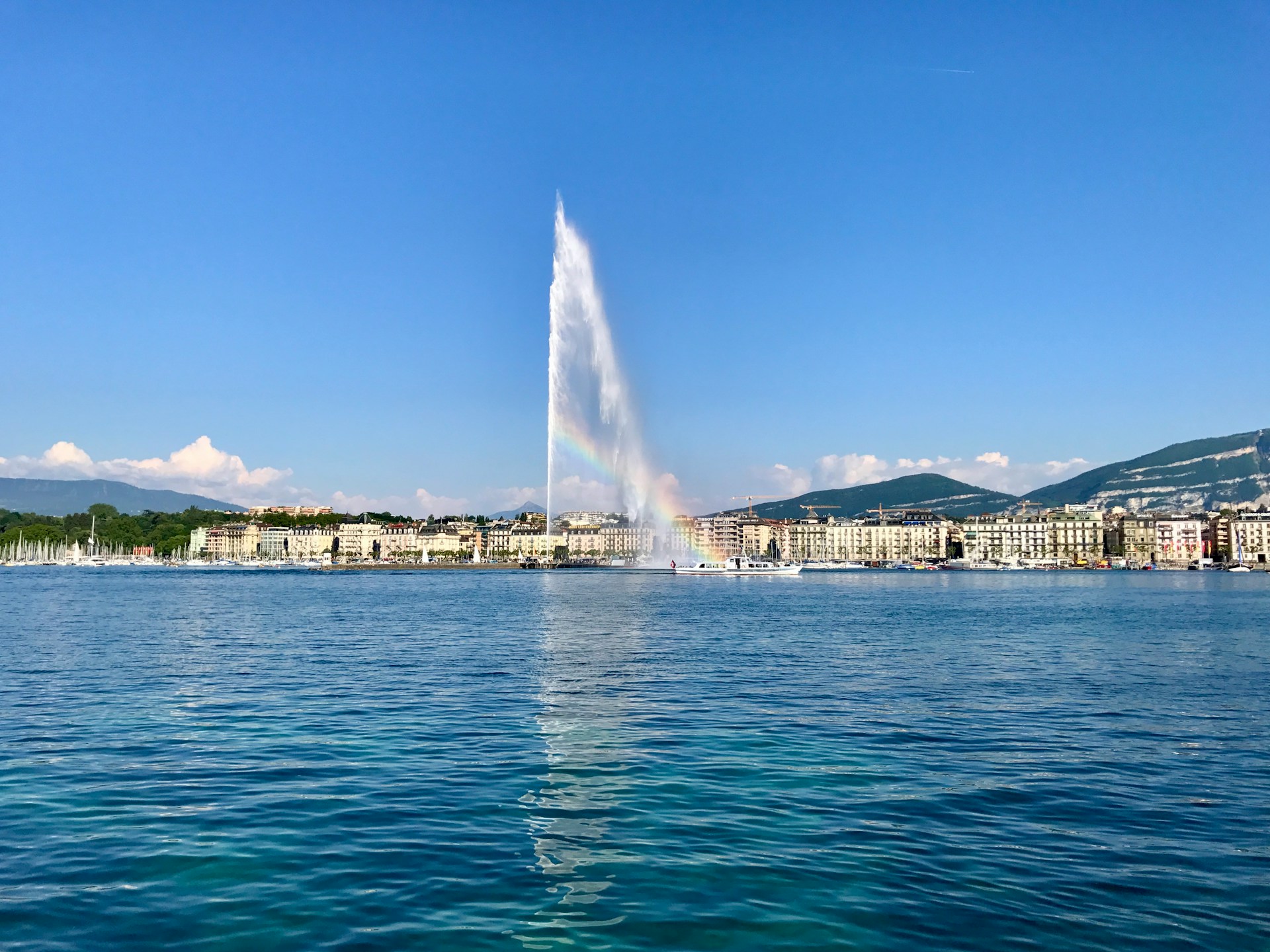
Geneva Airport handles over 17 million passengers a year and serves as the primary gateway for travellers heading to Geneva city, the Swiss Alps, and the neighbouring French resort regions. It is compact by major European airport standards, genuinely well signposted, and connected to the city centre in under 10 minutes by train. For most travellers arriving here, the process from touchdown to transport is relatively smooth. But there are a few things worth knowing before you land, especially if you are arriving with ski equipment, travelling with children, or heading to a mountain resort rather than the city itself.
This guide covers the arrivals experience step by step, including terminals, transport options, the free public transport ticket that most travellers do not know about, and the frequently asked questions that come up most often for passengers arriving at GVA for the first time.
Geneva Airport operates with two terminals, though in practice the distinction barely affects most arriving passengers.
Terminal 1 (T1) is the main terminal and handles over 90 percent of all flights. It is divided into a Schengen zone (Piers A and B, for flights within the Schengen Area) and a Non-Schengen zone (Piers C and D, for flights from the UK, US, Middle East, Asia, and other international routes). Both zones feed into the same central arrivals hall on the ground floor, so regardless of where your flight originates, you will end up in the same place once you clear customs and collect your bags.
Terminal 2 (T2) is a smaller, auxiliary terminal used only on Saturdays during the winter ski season, from December through February, for additional easyJet seasonal traffic. It is connected to T1 by a five-minute covered walkway, and both terminals share the same arrivals hall. If you are arriving on a winter weekend charter flight, your boarding pass will specify T2 and you will be bussed directly from the aircraft to the baggage hall.
There is also a French Sector within T1, known as Pier F or Secteur France. This zone handles domestic French flights and allows passengers to bypass Swiss customs entirely, connecting directly to the French road and transport network. The vast majority of travellers will not use this. It is relevant only if you are flying in on a domestic French route, such as from Paris Orly, and planning to go directly into France rather than entering Switzerland.
If your flight arrives from within the Schengen Area, you proceed directly to baggage claim with no passport check. If you are arriving from a non-Schengen country, including the UK, US, Canada, and most international long-haul routes, you will pass through Swiss passport control first. Queues at passport control are generally manageable, though they can extend during peak periods such as WEF Davos week, the Christmas and New Year period, and busy ski season weekends. Allow extra time on these dates.
After passport control, you proceed to the baggage claim hall. Before you exit to the arrivals hall, look for the bright yellow ticket dispensing machines on the wall. These provide a free 80-minute Unireso public transport ticket valid on buses, trams, trains, and boats within the Geneva canton. The ticket covers the train into the city centre and most Geneva city bus routes. You will need to show your boarding pass or plane ticket if inspected.
This is one of the most valuable and least publicised perks of arriving at Geneva Airport. For travellers heading into the city, it covers the train fare in full. Pick up the ticket before you leave the baggage hall, because the machines are not available once you exit into arrivals.
After baggage claim, you pass through customs. Switzerland is not in the European Union, so duty-free allowances apply for all arrivals including those coming from EU countries. Standard allowances include 1 litre of spirits over 18 percent, 2 litres of wine or beer, and a personal allowance of CHF 300 worth of other goods for non-commercial items. Luggage can be checked, particularly on routes where large volumes of undeclared goods have historically been flagged.
The arrivals hall is on the ground floor of T1. This is where you will find taxi ranks, private transfer drivers waiting with name signs, the bus stops for city services, the walkway to the train station, and car hire desks. The hall is compact and straightforward to navigate. Signage is in French, German, and English.
The fastest and most used option for reaching Geneva city centre. The airport has its own railway station, Geneve-Aeroport, located directly beneath the terminal. Trains run frequently to Geneva Cornavin, the main station, with a journey time of around 6 to 7 minutes. Trains run up to seven times per hour during peak periods. From Geneve Cornavin you can connect to trams and buses across the city, or continue by train to Lausanne, Bern, Zurich, and other Swiss cities.
If you picked up the free Unireso ticket in the baggage hall, this covers the train to Geneva Cornavin at no additional cost. The station entrance is a five-minute walk from the arrivals hall through the airport shopping centre.
Several bus lines depart from the airport and serve different parts of the city. Line 5 follows a scenic route through major hotel and tourist areas before reaching Place de Neuve. Line 10 connects to Geneva Cornavin and central zones. The Aerobus provides early morning complimentary transfers when you show a boarding pass. Bus frequency varies from 8 to 15 minutes during peak hours on urban lines to 20 to 30 minutes during off-peak periods on regional lines.
Official taxis queue immediately outside the arrivals hall exit. The journey to central Geneva takes approximately 10 to 20 minutes depending on traffic. Taxis in Geneva operate on a metered system and rates are among the highest in Europe, as is typical for Switzerland. Night surcharges and weekend rates apply. For a short journey to a city centre hotel, the taxi is convenient, particularly late at night when train frequency drops.
For travellers heading to ski resorts, travelling with a group, or arriving with significant luggage, a pre-booked private transfer is often the most practical choice. Unlike taxis, private transfers offer fixed pricing agreed in advance, a driver waiting in the arrivals hall with a name sign, and vehicles suited to carrying ski bags, child seats, and large suitcases. For a destination like Verbier, Chamonix, Zermatt, or St. Moritz, a private Swiss transfer takes you from the arrivals hall directly to your resort or hotel entrance without any connection or transfer.
Geneva Airport provides free high-speed Wi-Fi throughout the terminal. To connect, scan your boarding pass at a Wi-Fi kiosk or register with a mobile number to receive a verification code. Coverage extends across gates, lounges, and both the arrivals and departures halls. Speed is sufficient for video calls, emails, and streaming.
Switzerland uses the Swiss Franc (CHF). Euros are accepted at the airport and by many businesses in Geneva, though change is typically given back in CHF. ATMs are available throughout the terminal. Exchange offices at airports typically charge around a 5 percent spread, so withdrawing CHF from an ATM or using a travel card is usually more cost effective than exchanging at the desk.
Baggage storage is available 24 hours a day in Terminal 1 arrivals, level 0. Costs run from CHF 9 to CHF 13 per piece per day, with no reservation required. This is useful for travellers who want to explore the city before checking in to their hotel, or for those with a long layover between arrival and a connecting transfer.
Geneva Airport provides full accessibility assistance under EC Regulation 1107/2006. Wheelchair access, hearing loops, assistance vehicles, and meet-and-greet services are available. If you require assistance, pre-booking at least 48 hours in advance with your airline is recommended to ensure the service is ready when you land.
If you are arriving at Geneva Airport between December and March for a skiing trip, a few additional things apply. T2 is active on Saturdays during this period for additional seasonal flights, so check your boarding pass for the correct terminal. The airport is significantly busier on Saturdays and Sundays during peak ski weeks, including the Christmas and New Year period, school half terms in February, and Easter.
For ski resort transfers, the train from the airport will not take you all the way to your resort in most cases. A private transfer from the arrivals hall directly to the resort is the most common and practical solution for ski travellers, particularly when travelling with ski bags, snowboards, and children. Most transfer vehicles for this route have separate luggage compartments to keep ski equipment secure and out of the passenger cabin.
Is there a free ticket at Geneva Airport and how do I get it?
Yes. All arriving air passengers can collect a free 80-minute Unireso public transport ticket from yellow dispensing machines located in the baggage reclaim area, before you exit to the arrivals hall. The ticket covers trains, buses, trams, and boats within the Geneva canton, including the city centre. You may need to show your boarding pass or plane ticket if inspected. The machines are not available in the arrivals hall itself, so pick up the ticket before you leave the baggage area.
How long does it take to get from Geneva Airport to the city centre?
By train it takes 6 to 7 minutes from the airport station to Geneva Cornavin, the main city station. Trains run up to seven times per hour during peak periods and approximately every 12 to 20 minutes at quieter times. The first train to the city departs at 5:07 am and the last at around 12:51 am. By taxi the journey is 10 to 20 minutes depending on traffic. By bus it is 20 to 35 minutes.
Where do private transfer drivers wait at Geneva Airport?
Private Geneva airport transfer drivers wait in the arrivals hall on the ground floor of Terminal 1, typically holding a sign with the passenger's name. For passengers arriving via Terminal 2 during ski season, drivers may wait in the shared arrivals area accessible from both terminals.
What is the French Sector at Geneva Airport?
The French Sector, also called Pier F or Secteur France, is a dedicated section of Terminal 1 for domestic French flights. Passengers using this sector can arrive or depart without passing through Swiss customs, as they are technically accessing French territory. For most international travellers, the French Sector is not relevant. It applies primarily to those flying between Geneva and destinations within mainland France on domestic French routes.
How do I get from Geneva Airport to a ski resort like Verbier, Chamonix, or Zermatt?
Direct train connections to most ski resorts are not available from the airport. The most common options are shuttle buses operated by companies like Altibus for French resorts such as Chamonix, or pre-booked private transfers for Swiss resorts including Verbier, Zermatt, Crans-Montana, and Saas-Fee. Private transfers offer door-to-door service from the arrivals hall to your accommodation, with fixed pricing and space for ski equipment. Zermatt is a car-free village, so passengers travelling there must park in Tasch and take a local shuttle into the resort, or arrange a private transfer to Tasch.
Does Geneva Airport accept euros?
Yes. Euros are accepted at most airport shops, restaurants, and services. Change is typically returned in Swiss Francs. For better exchange rates, using a travel-friendly debit card or withdrawing CHF from an airport ATM is usually more cost effective than exchanging currency at the airport exchange desks, which typically charge around a 5 percent spread.
Is Geneva Airport open 24 hours?
The terminal building is open around the clock, but commercial flights observe a night curfew and do not operate between approximately 11 pm and 6 am. Shops and restaurants close in the late evening. The taxi rank operates 24 hours. Public transport including the train runs until around 12:30 am, with limited night bus services continuing after that. If you have a very early morning departure or a very late arrival, confirm your transport options in advance.
How early should I arrive at Geneva Airport for departure?
For Schengen flights, two hours before departure is generally sufficient. For non-Schengen flights including the UK, US, Middle East, and long-haul routes, three hours is recommended, particularly during busy periods such as Christmas, ski school holidays, WEF Davos week, and the Watches and Wonders fair in spring. Security averages around 8 minutes at quieter times but can extend to 25 to 35 minutes during the morning departure rush between 6 am and 9 am.
What currency does Switzerland use and can I use my card at the airport?
Switzerland uses the Swiss Franc (CHF). Major credit and debit cards including Visa, Mastercard, Amex, and UnionPay are accepted at virtually all airport outlets. ATMs are plentiful throughout the terminal and dispense CHF. Contactless payments work at most outlets. If your bank charges foreign transaction fees, using a travel card or a fee-free account for your Geneva trip will save money over several days.
| Street address | |||
| City | |||
| State | Zip code | ||
| Country | |||
| Street address | |||
| City | |||
| State | Zip code | ||
| Country | |||
| Street address | |||
| City | |||
| State | Zip code | ||
| Country | |||